
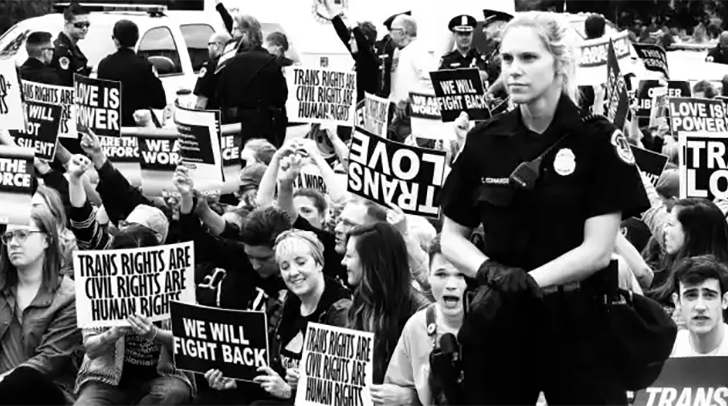
An interesting experience occurred two days after the 2024 Election. I was the guest speaker in a documentary filmmaking class at the University of Missouri, talking to a roomful of bright undergraduate and graduate students—all in the 20s or early 30s—supposedly about an historically important film, “Some of Your Best Friends,” the first documentary about the Gay Liberation movement shot primarily in Los Angeles. After viewing the film, seeing firsthand what grassroots activism looked like, much to my surprise and delight, the students wanted to talk about Trump’s victory more than the film, plaintively asking the same question in many different, interactive ways: What do we do now?
With humility that comes from aging, formal/informal study of history, and lived learning, I was able to provide an answer to that poignant and essential question. Since then, I have been asked that same question so many times by so many people of all ages and kinds that my old jaws were getting sore from giving the same answer repeatedly. Thus, the genesis of this article.
I realize there are many answers and different approaches to the question, what do we do now? The answer depends both on an individual’s circumstances in life and our collective action where there is a movement community, meaning, we assume responsibility for each other.
There is minimum tolerance for those who say, “I’m exhausted and tired of fighting.” My observation has been they are the people who are often doing the least actual fighting and much more whining. Many of us have no choice but to organize and fight some way or another, regardless of a lifetime of battle fatigue. As Martin Luther King, Jr. accurately said to a young friend of mine who was complaining, “It was a struggle yesterday. It’s a struggle today. It will be a struggle tomorrow. And if it isn’t a struggle, you’re doing something wrong.”
First, a High Alert to LGBTQ People and Their Allies
Roe vs. Wade was reversed by the U.S. Supreme Court on June 24, 2022, but that reversal was the result of a 20-year strategic legal plan that included relentless grassroots and religious activism, politicians incrementally eroding Roe here and there, having a stable full of extremely bright and imaginative attorneys, the development of the right legal arguments, being on the lookout for the right cases, shopping for the right judges and federal court districts, and having the right Supreme Court. Bingo!
In their exuberance over the reversal of Roe, Supreme Court Justices Thomas and Alito maladroitly revealed their next target: The reversal of same-sex marriage and the recriminalization of homosexual acts. The extreme right has already been hard at work for at least ten years strategizing how to accomplish those goals using modified Roe tactics.
As many LGBTQ people dance their hearts out, sashay on runways and are performative elsewhere, are lost on Netflix and other addictive aspects of visual culture, are indifferent to the diminishment of their community’s unity through assimilation and elite capture, and are politically complacent about the disappearance of any semblance of an organized LGBTQ movement, the adversary is awake and organized, implementing a long-range political and legal strategy that proved successful in reversing Roe. Over the last decade as I raised my voice with friends and colleagues about the slow disappearance of Roe without much pro-Roe organizing, unity, or fire, I was reassured that such a reversal of Roe was impossible after more than a half century of established law.
LGBTQ people and allies let the lessons of Roe be learned. Indifference, cynicism and complacency are no longer viable options. Briefly waking up politically a month or two before a national election and then dozing off again will not suffice. The LGBTQ elite, Human Rights Campaign, and their ilk are clueless now and their strategy of raising tons of money directed toward electoral politics has not been working well and has largely failed LGBTQ people as a whole. What to do? Howard Zinn taught us what to do in A People’s History of the United States: Organize! Organize! Organize! —from the bottom-up.
Three Suggestions for What to Do Now
First, it’s important to recognize an important historical reality, namely, Trump did not create his base, but his base created Trump. Trump’s recent reelection and the radical right’s capture of the three branches of government is the consequence of several decades of consistent and relentless organizing that included Ross Perot in 1992, Pat Buchanan in 2000 and before, and various other forays with incremental victories here and there, usually with growing, forward moving momentum. The election of 2024 has probably solidified that extreme rightward dominance for a generation or two until the next wave replaces it.
One of the roles of elders is to preserve and transmit history. Over the past 60 years, there have been two generational waves of profound political change. Beginning with the social change revolutions of the 1960s and 1970s, a political sea change slowly began to take place in the U.S. that grew in conscience and consciousness with forward moving, left-leaning momentum. In my first anti-Vietnam War action in 1967 there were about 25 demonstrators; a decade later tens of thousands were marching on the East and West Coasts and in cities here and there in between to end the war.
Out of those social revolutions grew the robust social and political movements of later years: Black, Latino, Asian, First Nation civil rights and justice; the equality of second-wave feminism and women’s health; environmentalism; LGBTQ liberation, an understanding of U.S. neo-imperialism, and so forth. Now a second generational sea change has transpired with ominous overtones so far that make even me, an intrinsic idealist and optimist, nervously wondering and tremoring from time to time, particularly when seeing the speed and quality of Trump recent appointees.
That current political sea change, which is of a generational nature, employed the same methodologies used by social change revolutionaries coming out of the 1960s and 1970s—conscious raising (now writ large by the new social media algorithms), grassroots organizing (from bottom-up, not top-down), creating a critical mass (not a huge majority) with forward-moving momentum, incremental victories that created a wave, and such things. Perhaps naively, if history is correct, I speculate the current generational shift in power will at some point become a hollow power structure amenable to the next generational wave of change. Progressive younger people, that future wave is you. Organize! Organize! Organize!—hopefully with older adults and elder allies actively joining in.
Second, enough of us need to understand, as Zinn tried to teach us in A People’s History, that political and societal change hardly ever comes from the top-down. Elite power always tries to preserve its power, not relinquish it. It’s an old, old story. Congress and presidents, with the customarily conservative Supreme Court plodding slowly behind, validate the critical mass, they do not create that critical mass.
When President Johnson urged Martin Luther King, Jr., in the Oval Office in the mid-1960’s to grant him more time to pass voting and civil rights laws, King could assertively and succinctly reply, “We have waited long enough,” because a national critical mass, not a whopping majority, had coalesced behind such laws from the bottom-up.
I do not know how the next grassroots wave will form or where it will come from. I do suggest that always whining only in the narcissistic present tense goes in circles, not forward.
I suggest further that the George Floyd murder witnessed on a simple cellphone in May 2020 may provide a successful model for how grassroots and netroots can work together for social change. In 2020, the internet and social media were a means to an end, getting people off their screens and voting with their feet on the streets everywhere, not an end in itself, with endless adversarial arguing and accusing or many fragmented bubbles with like-minded people talking to themselves.
The incredible success of the Floyd protests provides one hybrid model of a possible route forward—screens creating real hands and feet doing something concrete on the ground that brings actual participation by real people using imagination and audacity. Younger activists can pull it off if they have support from and dialogue with older adults and elders. The words of everybody’s ancestor, Albert Einstein, can be helpful — “Always plan to do the impossible.” Those words rang true for the early Gay Liberation Revolution when allies were few and far between.
Third, there is a critical need for some kind of new-old collective consciousness-raising tool that includes face-to-face talking and listening to each other in personal terms. Perhaps, again, a hybrid model of some kind. The early National Organization of Women’s manual on how to organize and conduct a woman-centered conscious-raising group spawned many such groups and brought countless women into the very successful Feminist movement. The NOW model was adapted and adopted by the early Gay Liberation movement with similar success as it has been for other communities. There is a critical need for such tools based on today’s communication realities that make people real participants again, not spectators.
Action grows out of oppression. Collective action grows out of our understanding of collective oppression and forming coalitions with others with similar-different collective oppression. The current wave taking control in Washington, D.C., has what many progressives pejoratively label as a “list of grievances,” but what that grassroots effort experiences as “collective oppression.” Of course, Trump and others, like most politicians, manipulate that collective oppression with entertainment values for personal political advantage.
During the past 25 years, I have organized and facilitated numerous intergenerational dialogues—from two people to 300—most recently last month that involved 50 people. It is another role of conscious elders, doing eldering with adults and youth, not just in the gay community but also including the larger community as well. I always try to slip in the question, “How are you oppressed today?” I am shocked by many answers, variations of “I am not oppressed today.” I try not to lose my cool but facilitate dialogue instead.
Recently, for example, I was having a substantive dialogue with an early 30s, bright, creative gay artist. Early in the conversation, he told me about taking a walk in his neighborhood and how homophobic hate words were hurled at him. Later, when I slipped in the question, he said he was not oppressed as a gay man.
When I mention to those under 35-years-old, like the class at the University of Missouri last week, that a consciousness-raising group might be one tool for what to do now. The class responded, as usual, with “what’s a consciousness-raising group?” The concept and practice were explained, the students hearing about CR groups for the first time.
Is it possible that older progressive adults and elders have abandoned willing younger people with the transmission of organizing tools that they desperately need for the struggle ahead of them? Older doers need to take the initiative, not younger folk. There is a natural alliance between the old and the young, in hetero language, between grandparents and grandchildren. Age apartheidhinders collective forward movement.
On his way to the gallows, Joe Hill shouted to us today: “Don’t mourn, organize!”