
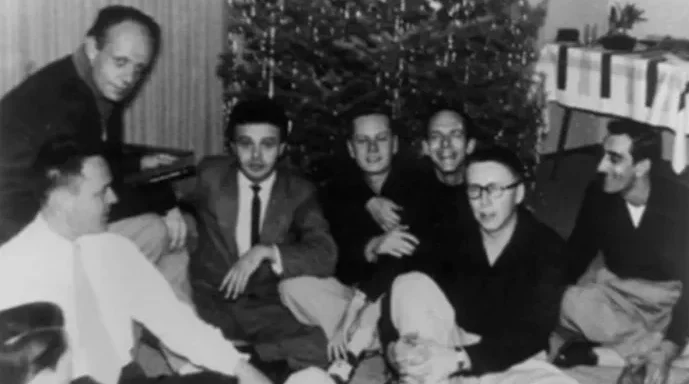
On November 11, 1950, Veteran’s Day, seven homosexual men met in a home in what was then called the Edendale section of Los Angeles, now referred to as Echo Park. They came together, secretly, recruited by Harry Hay to found the Mattachine Society, the commencement of the long march to freedom by LGBTQ people in the United States. A statue needs be erected in L.A. to honor those seven men: Hay, Bob Hull, Chuck Rowland, Rudi Gernreich, Dale Jennings, James Gruber, and Konrad Stevens.
I still get chills as I read the oath of initiation taken into the Mattachine that day to the sounds of Pachelbel’s “Canon” softly playing in the background, an oath eventually heard around the world:
“We are sworn that no boy or girl, approaching the maelstrom of deviation, need to make that crossing alone, afraid and in the dark ever again.”
In that oath about the “boy or girl,” the word “deviation” reverberates through a thousand years in the West of hetero supremacy and enforced heterosexualism with all that implies. All LGBTQ people were once that “boy or girl.” Thus began a core principle of LGBTQ community—we assume responsibility for each other.
November 11, 2025, marks the 75th anniversary of that moment. As far as my information at this time, as a gay elder, I’m embarrassed to report to those seven gay ancestors: Not a single event is planned in L.A. to commemorate that historic date, just as L.A. Pride occurred in WeHo on the 50th anniversary of the Stonewall Rebellion, the reason for Pride’s existence, without ever mentioning a word about Stonewall.

A rare photo of several of the founding members of Mattachine circa 1952 whose names are in capital letters. Clockwise from top: Konrad Stevens, an unidentified man, Bob Hull, Jim Gruber, Chuck Rowland.
While a very short-lived effort was made in Chicago in the 1920s, which was quickly broken up by the police, the Mattachine represents the first successful attempt in the U.S. at organizing homosexual men and women. They used the oppressor’s word, “homosexual,” to describe themselves. After World War II, several of the men had been members of or had flirted with the U.S. Communist Party or were members of other progressive organizations, where they learned organizing skills, analysis of social problems, and secret organizing. It was that secret organizing, as necessary as it may have been, that became its Achilles’ Heel. Hay was kicked out of the CP by CP leader Gus Hall’s purge of known or suspected homosexual men and women after World War II.
The name “Mattachine” came from the word “matticini,” one of the names for jesters in royal courts of medieval Europe which Hay deduced from his research were homosexual men.
The Mattachine is important for more than just existing for three years (1950-1953). In its original organizing “manifesto,” written by Hay, for the first time in U.S. history, homosexuals identified themselves as an oppressed minority group. The document also declared that a hidden homosexual culture existed. Also, it implied that collective political action was needed. That collective political action eventually came from Mattachine’s grandchildren with the fire and fervor of the collective action of the Gay Liberation Revolution (1969-1985)—the Great Awakening. Will Roscoe’s Radically Gay will introduce you to this valuable historical written material of the Mattachine.
The Mattachine was a top-down organization based on a secret model of five levels that had been used by the Free Masons in 15th century Europe and later employed during World War II by the French Resistance. The original seven members were on level-five and newcomers on level one, not knowing who was on the levels above them. Such organization, it was felt then, was necessary due to the viscousness and life destroying consequences at that time by U.S. hetero supremacists if homosexual identity were ever made public. Until the 1969 Stonewall Rebellion and its aftermath, sane paranoia based on individual protection and survival characterized homosexual reality.
The Mattachine’s most important contribution then was the use of private discussion groups that gave gay men and lesbians, for the first time, an opportunity to talk with each other about their lives and how hetero oppression was directly impacting them. But these groups often met cautiously.
There was one discussion group in an apartment building in Hollywood that required members to arrive as fake male-female couples, the men wearing male attire and the women in dresses, lest the neighbors suspect that a homo group was meeting next door and alert the LAPD, who could soon be knocking on the door.
By late 1952-early 1953, it was reported that Mattachine had created almost a hundred discussion groups in California with about 2000 participants, a stunning achievement for the early 1950s. There were also Mattachine organizations happening in New York City; Washington, D.C.; San Francisco; and elsewhere. The discussion groups by then were taking on a more grassroots character with a wide range of people from various political proclivities and social classes, but, given the enforced racial segregation practiced in L.A. then, virtually all were white. There were whispers about their own publication.
Then, in March 1953, all hell broke loose when Paul Coates, a widely read newspaper columnist in the U.S., reported publicly for the first time the existence of the Mattachine in Los Angeles and the ties of some of its organizers to the Communist Party during the Red Scare period. I speculate that Coates was tipped off by J. Edgar Hoover and the FBI who, after their first priority, the Red Scare, focused on their second priority, the Homo Scare.
The Mattachine was thrown into turmoil, not knowing whose outing was next, and the seven level-five men unmasked themselves.
At a meeting of the Mattachine at the First Unitarian Church, then on Crenshaw Blvd., in the Spring of 1953, Hay and other founders resigned in the best interest of the organization, which was taken over by conservative Hal Call and moved to San Francisco, which is a sad story for another time. In my many dialogues with Hay about this period, he always referred disdainfully to the San Francisco group as the “Second Mattachine,” to clearly differentiate it from the first.
Out of that chaos, in Los Angeles was formed ONE, Inc., which ushered in the conservative, Republican-led Homophile period (1953-1969), centered in Los Angeles, that recorded successes and failures which I have written about previously in the L.A. Progressive.
One essential way of understanding the Mattachine and Homophile periods is through the lens of the historiography of liberation movements. Both the Mattachine and Homophile years represented what is seen as “secondary resistance,” which involves the preparation of an oppressed people for liberation through discussion, writing, education, and some organizing of an elite nature. The “Big Bang” of the Gay Liberation Revolution was “primary resistance,” which involves direct action against the power of the oppressor, replaces it, and proactively creates a new sense of community free of the previous oppression. Or so they say.
One of my teachers, Malidoma Some, taught me about the importance of honoring ancestors as an essential ingredient of maintaining a healthy community. He also taught me about eldering. Among the Dagara people in Burkina Faso, from which he came and was an initiated shaman and initiated elder (also with two earned Ph.Ds. from the Paris Sorbonne University and Brandeis University), one of the important roles of elders was to scold the village for any shortcomings in fulfilling their responsibilities. Only elders had the authority to do that scolding.
As a Gay Tribal Elder, I send out a potential scold particularly to functioning and conscious LGBTQ adults and youth in the L.A. community. You are the boy or girl the Mattachine swore to protect. You are the great, great grandchildren of those pioneers. You have ancestor responsibilities. You might bring shame to a community by disregarding that important legacy. Being me, I also warmly say to you that you can always redeem yourselves. The 75thanniversary year of the Mattachine is just beginning on November 11, the founding date in 1950. There is time during this coming year to be accountable in some notable way.
As the remarkable poet Kevin Young wrote recently, “the dead won’t let/us be.”