
“Without community, there is no liberation.”
– Audre Lorde
After years of searching, a copy of an of an early Gay Community Services Center brochure (cover right below) was found, thanks to the incredible help of Loni Shibuyama at the USC-ONE Archives. Today, GCSC is called the Los Angeles LGBT Center, sometimes for the better, sometimes for the worse. Importantly, the word “community” was erased from the original name, with all that implies, namely, that accountability is primarily to donors, not community. Still today, my constructive and deeply felt support for the mission and soul of the Center has never wavered.
With nearly 60 years of continuous service directed, often driven, toward the well-being and welfare of LGBTQ people, I invite you to sit with me under a large shade tree somewhere in East Hollywood, where, as a Gay Tribal Elder, I will teach you how that GCSC brochure was critically central to your liberation.

Click on the image above to open a PDF of the full brochure.
The early Gay Liberation Revolution in L.A. can be divided into four phases, with leadership and catalyst roles played by the L.A. Gay Liberation Front:
First Phase 1969: Called together by Morris Kight in August, shortly after the June 28th Stonewall Rebellion, this first phase of L.A. GLF was characterized by politically aware people who met in a small group, that was fluid in composition and engaged every Sunday afternoon in a meeting, whose peripatetic location was announced weekly in the Los Angeles Free Press. The meeting served primarily as a gay consciousness raising group for members and secondarily as a planning session, notably for the Barney’s Beanery demonstrations in West Hollywood. A new chairperson was selected each month, in keeping with the horizontal leaderless style of the counterculture at that time. [In 1969, “gay” was an umbrella term used by Gay Liberation for men and women that replaced “homophile”; by the mid-1970s that gay identity changed in many different directions; and by the early 1980s “LGBT” was knocking at the door.]
Second Phase 1970: GLF secured its own office/meeting space at 577 ½ N. Vermont Ave. in East Hollywood and created the infrastructure for revolutionary Gay Liberation to fight back against systemic and institutionalized hetero supremacy through direct action and civil disobedience — a “Big Bang” historical moment for gay and lesbian people across the U.S. and beyond. In 2022, Dr. Craig Loftin, a gay historian at California State University (Fullerton) succinctly summed up L.A. GLF that year in a talk at USC, when he said:
“…1970 was an incredible year of achievement for GLF in Los Angeles. They staged marches, protests, zaps, interventions, and a broad range of other militant, highly visible actions. They fought back. They led the march out of the shadows, out of the closet.”
I have written extensively about this 1970 period elsewhere.
What is the difference between terms like “revolution” and “liberation movement” and a term like “civil rights movement?”
A revolution or liberation movement involves an oppressed group seizing power by its own militant efforts and includes a transformation in consciousness of an oppressed people about its alleged inferiority, restructures political, economic and educational systems, and claims or reclaims that group’s history and culture. A civil rights effort, on the other hand, lobbies the dominant power structure over time to bestow new rights—like marriage rights—which provide increased equality to a minority or majority historically discriminated against without any fundamental changes or threats to the power, political, economic, or educational systems in place.
Existing power structures try to destroy revolutions and liberation movements. Civil rights efforts are easily pacified by political posturing and pretending and assimilated by elite capture without posing much of a threat or challenge to the power structures of society.
Third Phase 1971: At the end of 1970, by amicable agreement, L.A. GLF went in two different directions, and the GLF office closed. A more moderate faction opened a coffee house on Melrose Ave. as a social alternative, which folded after a few months. More militant GLF members, including me, moved into the Hoover St. Commune together to continue the work of GLF and of its Gay Survival Committee, which I had called into being in 1970 and chaired, out of which GCSC was created. At the commune, the legal infrastructure and the community-based architecture of the pioneering center were formulated. See my essay here.
Fourth Phase October 1971: The fourth stage of L.A. GLF occurred with the opening of GCSC, with the primary intentions of (1) continuing the proactive organizing work of Gay Liberation, (2) tending to the real and immediate needs of gay and lesbian people, many suffering from oppression sickness, and (3) creating a visible, organized and assertive gay community in L.A. for the first time ever. Since early 1970, with the founding of GLF’s Gay Survival Committee, I had been the relentless and driven vision carrier for that effort. I was the founding executive director of GCSC, and I was called its co-founder (with Morris Kight), which is true, in part. The complementary truth is that GCSC was also collectively created by radical members of L.A. GLF, the Hoover St. Commune, the Highland Park Collective, and countless other people who made it happen — hundreds of incredible, highly motivated volunteers, including Kight and me, creating something that had never existed before anywhere. May their souls rest in peace.
All this history is by way of introduction to a 1972-73 iteration of the original GCSC brochure which will give you an overview of what was happening at GCSC then. Tens of thousands of these brochures were distributed all over the place, leaving no stone unturned.
It is important that you understand, all that revolting behavior and in-your-face, proactive community organizing was taking place at a time gay and lesbian people were: (1) considered gravely sinful and an abomination in the eyes of Hashem-God-Allah by all monotheistic religions and others, (2) labeled as criminals by laws and law enforcement at local, state and federal levels, and (3) stigmatized as sick and needing to be cured by psychologists and psychiatrists—all within the subtext of eliminating gay and lesbian people, one way or another. That was why the committee was named the “Gay Survival Committee” in 1970.
The essential historical takeaway of this brochure is that nowhere, except in Los Angeles at that time and after 1000 years of continuous, brutal hetero supremacy in the West, had the world, nor gay and lesbian people, ever seen such a Center before, and, in many countries, probably still.
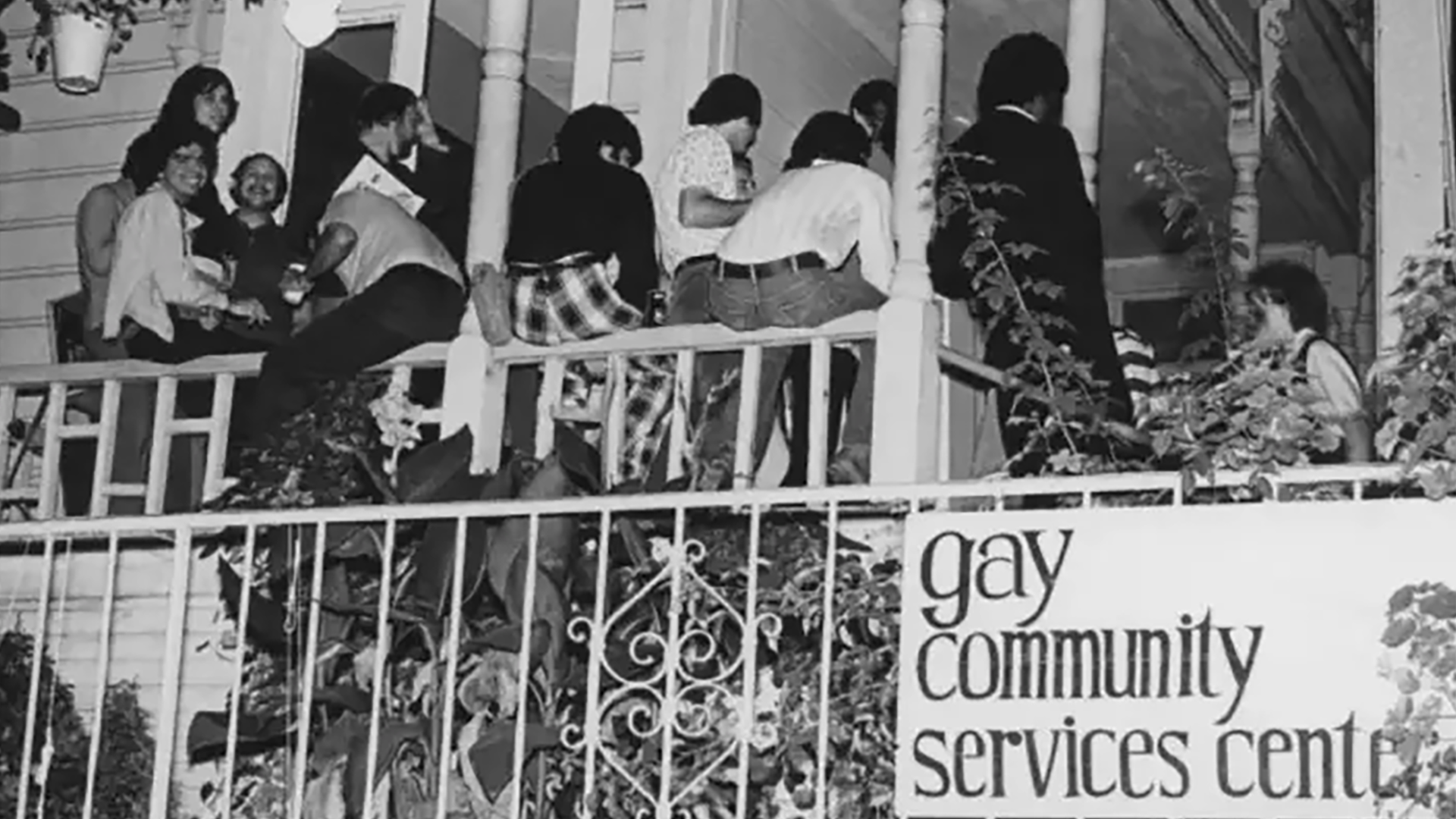
Literally, around the clock, the Center was a busy human service agency and bustling, thriving community center rolled into one, with a big sign in front emblazoned with the words “Gay Community Services Center” — a legal and tax exempt California public service corporation, soon to be federally tax exempt as well, with attempted push back by the Nixon White House. Soon, there was a glowing story about GCSC on the front page of the Los Angeles Times and shows about the Center on every major radio-television station in the city.
Hetero supremacists, most heteros then, were stunned, discombobulated, and speechless by L.A. GLF’s fearless audacity and political sophistication, knowing they could no longer intimidate and brutalize gay and lesbian people through fear and physical violence. In L.A. and elsewhere across the country, a social revolution of major historical importance was happening for the first time in the U.S. and beyond.
At 87, I find the phrase “Power to the People!” vibrates in my heart and soul stronger than ever.
Remember, try to remember, Audre Lorde’s words: “Without community, there is no liberation.” Reflect the times. Get uppity. Fight the revolution forward.
"It always seems impossible until it is done."
–Nelson Mandela
* * *
The brochure (cover and inside art by Bruce Reifel, gifted L.A. Gay Liberation and Radical Faeries artist) can be downloaded and opened here.