
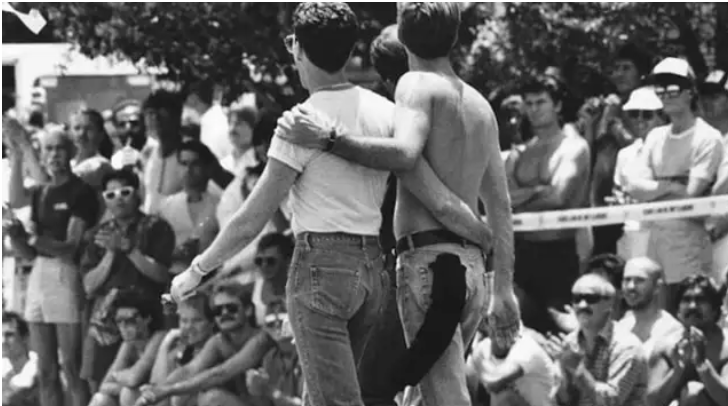
Elite Capture has largely failed LGBTQ people. Our hetero supremacist oppressors, however, using grassroots, community-based tactics, are running circles around queers in political activism.
Why did the LGBTQ Human Rights Campaign (HRC) issue only a measly “Advisory” rather than a militant “Boycott” of Florida after extreme anti-LGBTQ laws and other outrages were engineered there recently?
Ordinary LGBTQ people and our allies overwhelmingly would have supported a direct, mass political action such as a well-planned and adroitly-managed boycottof Florida. What happened?
It was not in the economic and social interests/values of those who fund and control HRC and other major organizations to “Boycott Florida.” Today, their self-interest dictates what amounts to a narrow, self-referential LGBTQ political agenda—electoral politics, fundraising, platitudes—and it is having a destructive impact on the vitality, visibility, unity, and constructive forward movement of LGBTQ communities everywhere.
Previously, in explaining the political evolution of the L.A. gay community, the present era was labeled the Neo-Homophile period (circa 1990-present) because of its similarities to the pre-Gay Liberation Homophile period (1953-1969). The two periods have a basic resonance with each other even though there is not always a strict one-to-one correspondence—assimilation, hetero imitation, moderate to conservative politics, and a woefully mistaken belief that if LGBTQ folk just behaved themselves hetero supremacists would accept them.
There is a critical need today for a Queer Liberation movement, by that name or another, to replace the contemporary Neo-Homophile political stagnation and social complacency in the LGBTQ community in Los Angeles (and elsewhere). Trying to go back to a Gay Liberation model of the 1970s and 1980s is not the answer, nor is it even possible. A proposal will be made later for moving the community forward to meet the current political and cultural demands.
Within a race, class, and gender structure, how might the current Neo-Homophile period be intellectually understood? An understanding of “Elite Capture” is essential.
What Is Elite Capture?
The idea of Elite Capture is not new, as Black scholars have taught us. Carter G. Woodson in The Mis-Education of the Negro (1933) talked about Elite Capture conceptually, as did Frantz Fanon in Black Skin, White Masks (1952) in a colonial and post-colonial African context, as did E. Franklin Frazier in Black Bourgeoisie(1957) in an African American context, as did Angela Davis in Women, Race and Class (1981) in a feminist context.

Olufemi O Taiwo and his book Elite Capture
Recently, Georgetown University philosophy professor Olufemi O. Taiwo has done us a great favor by pulling together most of the 20th and early 21stcenturies’ literature on the subject in his Elite Capture: How the Powerful Took Over Identity Politics (And Everything Else) (Haymarket Books; 121 pages), amplifying the topic with his own considerable understanding. Taiwo takes what could be a complex intersectional subject and brings intellectual clarity to its layered reality.
For the sake of clarity, a few short definitions might be helpful. Remember, however, there are no hard and fast rules when it comes to Elite Capture. Critical intelligence is essential.
According to Taiwo, Elite Capture “happens when the advantaged few steer resources and institutions that could serve the many toward their own narrow interests and aims.” Usually, Elite Capture is determined by education, wealth, and social prestige.
Political scientist Jo Freeman defines the word “elite” as “a small group of people who have power over a larger group of which they are a part, usually without direct responsibility to the larger group, and often without their knowledge and consent.”
German economic sociologist Wolfgang Streeck, Emeritus Director at the Max Planck Institute for the Study of Societies, describes three essential features of Elite Capture:
- Less collective action by people.Community-based, grassroots political and cultural organizing decreases with the larger part of the community becoming spectators rather than participants in the political and social wellbeing of the community.
- More remote decision sites. The political and cultural agendas of the community are determined by a narrow elite based on its own self-interests and values. These agendas are delivered in a top-down manner using venues and tools, like key organizations and electronic and print media, controlled by the elite.
- Rise of technocrats. To serve and often to be a part of the elite, a well-educated and often well-connected class of people emerges that helps to formulate and deliver the elite’s agendas to the larger community one way or another. The smaller elite enclave thinks it knows what is best for the larger community without ever having actual contact with the community and knowing its felt needs. The key question with Elite Capture is always, whom does it serve?
Taiwo uses the term “identity politics” in terms of colonial liberation movements as well as liberation efforts in the United States, including LGBTQ liberation. Elite Capture has yet to enter the consciousness and political and cultural vocabulary of LGBTQ people. I suggest that it is because, in the words of Frantz Fanon, there is much “willful narcissism” and “intellectual laziness” within the LGBTQ community.
Currently, Elite Capture’s poster-man is Pete Buttigieg—“telegenic, monogamous, white, financially secure, and vocally Christian.”
Elite Capture in the Los Angeles LGBTQ Community (And Everywhere Else)
During the past half-century plus, I have had the unique opportunity of being in the room or having a front row seat for the evolution of the Los Angeles LGBTQ community. Beginning in my late 20s, before there was a visible gay community, I assisted as a political midwife in delivering that community into being and have continued serving that community, one way or another, for over 55 years. At 85 years old, I am writing this essay from the lived knowledge and time perspective of a gay tribal elder. First, a few clarifications are in order:
- In this essay, the word “elite” is not being used in a Trumpist, MAGA manner to divide, polarize and demonize.
- My primary purpose is to describe the power phenomenology of Elite Capture in the community and its consequences for queer people, particularly for those under 40-years-old who know the community only in its Elite Capture stage of development.
- I have known every stratum and sector of the LGBTQ community in L.A. and have experienced genuinely decent, politically aware and generous individuals as well as ego-centric, self-serving grifters in each of those strata and sectors.
- A macro historical view will be utilized in this article while many micro examples are waiting in the wings for intelligent, gay-centered, highly-motivated LGBTQ historians and others.
The pivotal, Big Bang event in U.S. LGBTQ history was the 1969 Stonewall Rebellion that lit the fuse for the Gay Liberation revolution. During the early 1970s, for the first time in L.A., a visible, organized, and politically assertive gay and lesbian community emerged. It was grassroots, community-based and militant and the L.A. Gay Liberation Front/Gay Community Services Center was a central hub to those developments.
During the 1970s, L.A. had an outsize influence in national gay developments because The Advocate, the only national gay and lesbian publication, then founded and headquartered in L.A., almost exclusively covered the radical, proactive actions of the L.A. GLF/GCSC. During the 1970s, newly minted activists from all over the U.S. came to Los Angeles to study what was happening here, and, using L.A. as a community-based model of organizing, went home inspired.
Exhibit “A”: The AIDS Pandemic
The pivotal event of Elite Capture in queer L.A. was the AIDS pandemic. In 1982, the gay and lesbian community went into the great unknown of the then catastrophic AIDS struggle with a largely grassroots community intact, even though Elite Capture was slowly creeping in. Twenty years later, in the late 1990s when the AIDS tide was turned by protease inhibitors, the LGBTQ community was firmly in Elite Capture. How did that occur?
 Recently, I attended a private screening of a new documentary film—Commitment To Life—produced by the AIDS Project Los Angeles and soon to be released on Frameline. The film is focused on the L.A. community’s heroic fight against AIDS which often has been overlooked by primarily East coast and San Francisco AIDS coverage. The film is “Exhibit A” in the understanding of Elite Capture.
Remember, APLA did good work before Elite Capture and it has done good work since that occurred. Here we are looking at the relocation of the locus of power in the LGBTQ community, not personalities, and its historical consequences, particularly for our young.
The first half of Commitment To Life correctly shows the beginning stage of the plague; the panicked, frightened response of gay men; and the valiant, grassroots effort by the community-based APLA on Cole Avenue in Hollywood. Then, midway through the film—Bang!—Rock Hudson has AIDS; Elizabeth Taylor reigns supreme; and rich, white, gay men became the focus for the rest of the film to the virtual exclusion of anything else.
At one point, the president of APLA proudly reports that he called David Geffen asking for $1 million and minutes later it is in the organization’s bank account. Jeffrey Katzenberg, the film mogul, helicoptered into an APLA Board meeting at a high-end hotel in Dana Point, California, stayed a short while, and then helicoptered away—not exactly grassroots.
In those difficult times, I greatly appreciated that all hands were on deck helping homo and hetero men and women of all races and classes survive during the devastating AIDS crisis which is still not completely over. The Minority AIDS Project, Bienestar, ACT UP LA, the Los Angeles LGBT Center, AIDS Hospice Foundation and others, however, at best get cursory mention in the film. It feels more like an infomercial for Elite Capture of APLA than a documentary about a community effort.
An unintended and never discussed consequence of the AIDS catastrophe in L.A. (and elsewhere) was that the LGBTQ community changed from a largely bottom-up, community-based, diffused power arrangement to a top-down, elite, wealthy, white power structure. As folk wisdom tells us, “He who pays the piper picks the tune.”
Exhibit “B”: The Coors Boycott in the Late 1990s
A second example of Elite Capture is the 1997-1999 betrayal of the Coors Boycott, the LGBTQ community’s most successful boycott. This example clearly shows the difference between a grassroots, community-based agenda and the narrow values of Elite Capture.
A grassroots boycott against Coors was started in 1973 in the gay community, largely west of the Rockies, because the Coors family with its beer profits funded the most virulent, hetero supremacist individuals and organizations in the U.S. Extreme right-wing Coors wanted to destroy every advance gay and lesbian had ever made. At one point, just about every gay and lesbian bar in California, Oregon, Washington, and other western states refused to sell Coors beer, significantly hurting its sales.
Coming out of the AIDS pandemic in the late 1990s, the newly empowered political and business elite in the community tried to make the community falsely believe that the boycott was over, which it was not, and that Coors was our friend.
The West Hollywood City Council, an important avenue of Elite Capture, approved banners all over the city saying Coors was sponsoring Outfest. It gave the impression that Coors had changed, otherwise, why would Outfest accept Coors sponsorship and WeHo’s support? Coors money was doled out in small amounts to AIDS organizations, Outfest, the LA LGBT Center, GLAAD, and community newspapers in the form of full-page, full-color ads. All designed to con the community into believing that Coors had changed.
The L.A. Coors Boycott Committee fought back assertively with an educational campaign about what Coors and its gay and lesbian elite allies were up to. Christopher Street West, then the organizers of the annual Pride celebration in WeHo, was caught in the middle being pulled in one direction by the grassroots community and in another by the Elite Capture contingent claiming the community was tired of the boycott and wanted it to end, basically allying itself with the ultra right-wing, hetero supremacist Coors Brewing Co.
CSW hired a professional pollster to create a brief questionnaire to be administered to the large numbers entering the Pride festival after the parade. If the entrants knew about the Coors Boycott, they were asked if it should continue. Nearly 70% of the respondents said “Yes!”
This is an important example of Elite Capture in operation, using wealth and power in its own behalf, not the community’s best interest. The interests and political agenda of the smaller elite group—in this case, gay politicians and businesspeople—are often not the same as the interests of the larger community. These days, Elite Capture usually wins out.
“Exhibit “C”: Geographical Relocation of Power
Recently, the Los Angeles Times referred to West Hollywood as “the epicenter of queer life in So-Cal….” A third feature of Elite Capture in L.A. has been that the geographical epicenter of the LGBTQ community relocated, from fairly ordinary neighborhoods to very wealthy enclaves.
Prior to the creation of a visible and vocal gay community in L.A. in the early 1970s, small concentrations of gay men occurred after World War II on Bunker Hill in downtown L.A. where the Disney Concert Hall and other cultural institutions now stand (see John Rechy’s City of Night, 1963), then moved west to the Westlake Park area (now called MacArthur Park), then moving north to Echo Park—all invisible to the hetero eye except the LAPD.
The source of activists/volunteers for the L.A. Gay Liberation Front/Gay Community Services Center in the early 1970s—and the hub of an emerging visible and verbal community—was primarily along the largely working/middle class, culturally diverse, Echo Park-Silverlake-East Hollywood-Hollywood flatlands-North Hollywood corridor with nascent visibility beginning to sprout in South and East L.A., Pasadena, Venice/Santa Monica, and Long Beach.
The Elite Capture of the LGBTQ community resulting from the AIDS pandemic shifted its epicenter to the West Hollywood-Hollywood Hills-Beverly Hills-Brentwood nexus where it is found today. Here’s the irony: the most consistent, gay resistance to the Gay Liberation Front in L.A. came from homophiles and homos in West Hollywood. That struggle still continues in disguised ways today. The question: community-based leadership or wealth-based leadership?
WeHo’s demographics are just the opposite of those of the LGBTQ community in Los Angeles, which is majority non-white, and economically offended by WeHo’s wealth and pretensions.
Here’s the problem, as stark as day is to night, as grassroots is to Elite Capture, the 1.9 square miles of WeHo has the elite power currently, but it does not resemble the L.A. LGBTQ community in any significant demographic manner. The vox populiare many on this issue. WeHo is extremely wealthy, privileged, white, and entitled with a history of blatant racism in the gay and larger communities there. WeHo’s demographics are just the opposite of those of the LGBTQ community in Los Angeles, which is majority non-white, and economically offended by WeHo’s wealth and pretensions.
Elite Capture does not care what a community thinks and uses the word “community” as a shibboleth only when it serves their narrow interests.
Elite Capture
Can you imagine celebrating July 4th as American Pride Day with parades, bacchanalias, and high-priced, mass entertainment without ever mentioning the Declaration of Independence or the American Revolution? Under Elite Capture, that’s exactly what has occurred to Pride [the word always sounded like a dish-washing detergent to me]. The revolutionary Stonewall Rebellion and Gay Liberation movement, and what they represented politically, are anathema to Elite Capture.
The Stonewall celebrations began in 1970 on Hollywood Boulevard as a grassroots, community-based march. Its purpose was political and served a liberation consciousness and community organizing agenda unleashed by Stonewall.
In 2019, which marked the 50th anniversary of the Stonewall Rebellion—the seminal event that has spawned Pride celebrations worldwide—not a mention of Stonewall occurred in WeHo Pride, by then the only Pride in L.A. Los Angeles Pride had largely been subsumed by WeHo Pride because of the large amounts of money and services provided by the WeHo City Council. Elite Capture of the event had become total.
Today, WeHo Pride is the biggest money-making event of the year for the City of West Hollywood and its hotels, bars, and restaurants have become a Pride tourist destination with non-stop parties and entertainment for 72 hours during Pride weekend—no raised fists allowed. It is organized by a well-paid event planning company—no grassroots to be seen. Pitifully, in 2023, Friday night, the slowest of the WeHo Pride weekend, was designated as “Free Night” with everything that implies.
In 2022, as a result of WeHo elite’s arrogance and the justified outrage of LGBTQ people of color, L.A. Pride was disentangled from WeHo Pride and returned to its roots on Hollywood Boulevard. The jury is still out on L.A. Pride, just across the street from WeHo Pride, so to speak, as to it becoming a community-based event again with forward-leaning political content in sync with the larger LGBTQ community.
Jewel Thais-Williams and I have made the case for moving L.A. Pride to downtown L.A., the center of Los Angeles, an event that could be reimagined forward with a unique, creative LGBTQ-centered soul and united community, not a commercial hostage of Elite Capture.
Exhibit “E”: Social Media and the Disappearance of Investigative Journalism
The Los Angeles gay and lesbian community has a rich history of print journalism.
In 1967, The Advocate, the first gay newspaper in the U.S., was published in L.A. by Dick Michaels (a pseudonym for Richard Mitch) and his companion Bill Rand (Bill Rau). It grew out of the newsletter of the short-lived, proto-Gay Liberation organization P.R.I.D.E. (Personal Rights in Defense and Education) whose roots stem from the Society for Individual Rights (SIR) in San Francisco. The Advocate primarily focused on L.A. gay news even though in 1969 it became a national publication.
After Stonewall, the Los Angeles Free Press, with its national circulation, also became a major ally of the Gay Liberation movement in L.A. The Lesbian Tide, published by Jeanne Cordova, became a leading voice for lesbian feminism in the country. Then there were Edge, Frontiers, Lesbian News, and many more community newspapers and magazines. The news cubicles outside the Pleasure Chest in WeHo were once overflowing with all sorts of publications, unifying a community. Today they no longer exist.
Beginning in the late 20th century a technology-based communications revolution occurred and community-based print news largely disappeared, resulting in Elite Capture of a diminished queer journalism. If you are under 40-years-old and visual culture—screens and social media—is all you have known, you generally are not aware of how narrow, shallow and monocultural LGBTQ electronic media information has become under Elite Capture. Intellectual voices outside the LGBTQ community are vociferous and ubiquitous about this diminishment nationally; in the LGBTQ community, with total Elite Capture of the media, there is silence.
In the LGBTQ community nationally, there is merely one intellectual journal—The Gay & Lesbian Review out of Boston—published and edited by Richard Schneider, Jr. and now celebrating its 30th anniversary. When I mention it to queer men and women under 40, they have never heard of it.
Under Elite Capture, gay journalism has lost its bite. Today, with largely invisible corporate ownership, do you know who owns and runs the queer news sites you are watching? There is no masthead. Do you know the political and economic views of the owners that you are enriching? There are no editorials. Does your LGBTQ news site get angry, make demands, raise awareness, or unite a community that is woefully fragmented by visual culture/social media? Or is it designed by Elite Capture to make money and not offend anyone by being vacuous, sensational, platitudinous, and housebroken with narrow coverage of bland politicians, real or make-believe celebrities, and vapid influencers—number of clicks and followers more important than gay-centered political content or investigations in depth.
Two glaring gaps exist in the LGBTQ electronic media in L.A. First is the disappearance of local news and, when it does appear, it is skewed toward the political and social agenda of Elite Capture. For example, there is an important, thriving, queer-influenced creative blossoming occurring in the Highland Park section of L.A., but you would never know it from LGBTQ media coverage.
Second is the total elimination of gay-centered investigative journalism; someone over 40-years-old might faintly remember such articles in the gay media.
Under Elite Capture, gay investigative reporting has completely disappeared. There is nothing like a LGBTQ ProPublica anywhere. Without investigative journalism, a community can easily be manipulated by wealth and showmanship and does not have the information it needs to understand what is happening nor to tend to the collective welfare of the community.
Exhibit “F”: Community Organizations Then and Now
As Olufemi O. Taiwo points out, grassroots, community-based organizations that grew out of the political and social revolutions of the 1960s and 1970s have been completely taken over by Elite Capture with its narrow values, assimilationist ideology, and status quo political agenda. That’s certainly true for the LGBTQ community in Los Angeles (and elsewhere). Earlier, I described such a process of Elite Capture with AIDS Project Los Angeles. Here are three other L.A. examples among many more.
- AIDS Healthcare Foundation: Its roots are to be found in the Marxist-oriented Lavender and Red Union of the 1970s, influencing the creation of the grassroots AIDS Hospice Foundation in the 1980s, that, with a one-word name change, became today’s AIDS Healthcare Foundation. It involved more, however, than just a name change. While AHF does important work, Elite Capture of AHF has replaced grassroots values and organizing. Growing extremely successful through its cozy alliance with the pharmaceutical industry, AHF created a wealthy leadership disconnected from the needs of the L.A. gay community. The meaning of its early words, “Power to the People,” have been replaced by “Power to the CEO.”
- Los Angeles LGBT Center: As a cofounder (with Morris Kight) and founding executive director, I know considerable about the history of the Center. It grew out of GLF’s Gay Survival Committee which I called into being, chaired, and guided until that committee opened as the Gay Community Services Center in October of 1971. It was the first of its kind and is still the largest in the world.
The Center’s primary purpose, as its original revolutionary name implied—Gay Community Services Center—was to be a hub around which a visible, organized, and assertive gay community could coalesce in L.A. for the first time with two core values:
- gay and lesbian people assuming responsibility for each other, which meant everyone, and
- visibly and vocally advocating for the community’s wellbeing, which also meant everyone.
In the 1990s, the Center emerged from the AIDS pandemic in a state of Elite Capture although it had been creeping in that direction previously. The Center has done good work both before and after Elite Capture. However—and most importantly—a widely based, grassroots, community-centered, horizontal effort that had sustained the Center for over two decades had reoriented itself in a vertical direction with a hierarchy based largely on wealth, status, and celebrity.
In the late 1990s, as part of the attempt at Elite Capture of the community, the Center accepted $35,000 for a pool party fundraiser from the Coors Brewing Co. whose profits, it was well-known, funded major anti-LGBTQ efforts across the U.S. Numerous Center staff members contacted me privately, saying they totally supported what the Coors Boycott Committee was doing, however, if they were seen in public at protests with Morris Kight and me, they would be afraid of losing their Center employment.
Today, if you pay the right price, you can get a doorway there named in your honor. ProPublica reported that in 2021 the annual salary of the Center’s CEO was $667,414, among the 1% who earn more than $611,000 a year according to The New York Times.
The Center has attempted to rewrite its founding history to bring it more in line with the political values of Elite Capture. Its 1970-1971 origins growing out of the radical, militant GLF have been erased, and Morris Kight and I have been de facto declared non-persons and persona non grata.
At the Center’s 50th anniversary celebration, I was seated close to the kitchen door where I could not even see the table of honor in the far distance. While I was acknowledged once as the Center’s founding executive director (Kight’s name was never mentioned), the Center’s leadership refused to mention Morris Kight and me as cofounders, a blatant Elite Capture rewriting of gay history.
- USC-ONE Archive: In 1953, ONE, Inc., led by a coterie of conservative Republicans, grew out of the ashes of the pioneering Mattachine. While opposed to the revolutionary tactics of the Gay Liberation movement, ONE’s library and its important, every-Sunday-afternoon gay lecture series intellectually fed several generations of gay and lesbian people in L.A who knew about them. I spoke there often.
ONE’s history was bumpy, but it was a grassroots, community-based effort.
In the early 21st century, again coming out of the AIDS pandemic, Elite Capture occurred and basically dissolved ONE as it had been known since 1953.
ONE’s financial and other assets were legally and officially bequeathed to the Williams Institute at the UCLA Law School. ONE’s Education Committee, controlled by a gaggle of University of Southern California gay academic elites, hijacked the name, and claimed the ONE library and archives as its own; persuaded USC to provide housing for the collection; and was officially absorbed into the USC library system. USC is a supremely wealthy and politically conservative university, fought allowing a Gay Student Union on campus for decades, and is a leading U.S. university cheerleader for unbridled capitalism.
Thus, another important gay community-based institution in L.A. experienced Elite Capture. Today, the USC-ONE archives focuses almost entirely on Homophile and Neo-Homophile historical events and activities and, like WeHo Pride, pretends that the Gay Liberation movement never happened.
Elite Capture and Queer Postactivism
The vital question is: How do we get LGBTQ people to be participants in their continued liberation instead of just spectators? My experience during the past decade in dialoguing with many queer men younger than 40 about the grassroots political paralysis in the community goes something like this:
Young Queer: “What are we going to do about the victories of the extreme right-wing? OMG, the queer sky is falling!”
Don: “Do what Howard Zinn (A People’s History of the United States, 1980) suggested when someone asked him, ‘What are we going to do about George W. Bush? OMG, the sky is falling!’ Zinn calmly replied, ‘Do what Americans have always done, Organize! Organize! Organize!’”
Young Queer: “What do you mean organize? What does that mean?”
The disappearance/deactivation of Gay Liberation elders and Elite Capture of the LGBTQ community have deprived queers under 40 of a generational transfer of lived knowledge that is essential to the continued political and cultural evolution of the community in L.A. (and everywhere), much like the death of elders during the AIDS pandemic in South Africa deprived the young from knowing where to dig for life saving roots and tubers during a drought or famine.
Stay tuned. A way forward will be suggested.