
On September 2, 2025, Millersville University, a branch of the Pennsylvania state university system, bestowed an alumni achievement award on me, honoring my life’s work on behalf of LGBTQ people and community.
In 1955, early in my senior year at Ephrata High School in Pennsylvania, my boyfriend and I explored the expansive, bucolic Millersville University campus, and I knew immediately that this was the place I wanted to go to become a high school history teacher. Coming from a hard working poor family where just graduating from high school was rare, I had no idea how to apply, read the college catalogue (what did a “unit” mean), or where I would get the money to pull it off. Somehow, I figured it out. As always, the path reveals itself by beginning to walk the path.
At that time, the 1950s, if I had been an openly gay person, I would not have been accepted into the college and expelled immediately if it was found out. It would have made me open to possible criminal arrest and dehumanizing harassment. And I would not have been allowed to teach children anywhere.
So, that honor at a university dinner September 2, addressed by Dr. Daniel Wubah, president of the university, with trustees and others in attendance, was a particularly deeply felt, poignant moment in my life. I attended by Zoom and Jason Zimmerman, my nephew and MU graduate in 2015, accepted the award on my behalf.

Jason Zimmerman, Don's nephew and 2015 graduate of MU, accepting the alumni award on Don's behalf from Millersville University President Wubah.
The fact that 70 years after first setting foot on that campus, I was being honored by Millersville University for my 60 years of work helping to liberate and to tend to the welfare and well-being of the body and soul of gay people was a bit surreal. Hearing the words “Gay Liberation,” “Los Angeles LGBT Center,” and “Radical Faeries” spoken in an honoring context on that conservative campus was frankly, MINDBLOWING.

College library where Don spent much time between 1956-1960. Photo: William E. Fischer, Jr.
From 1956, as a frightened, 18-year-old freshman, until I graduated in 1960, Millersville University gave birth in me to an incredible intellectual aliveness that also included a love of reading and research and instilled responsibility and accountability, a foundation upon which the rest of my life would be built. But it wasn’t easy.
Literally Getting There Was the Other Half of the Struggle
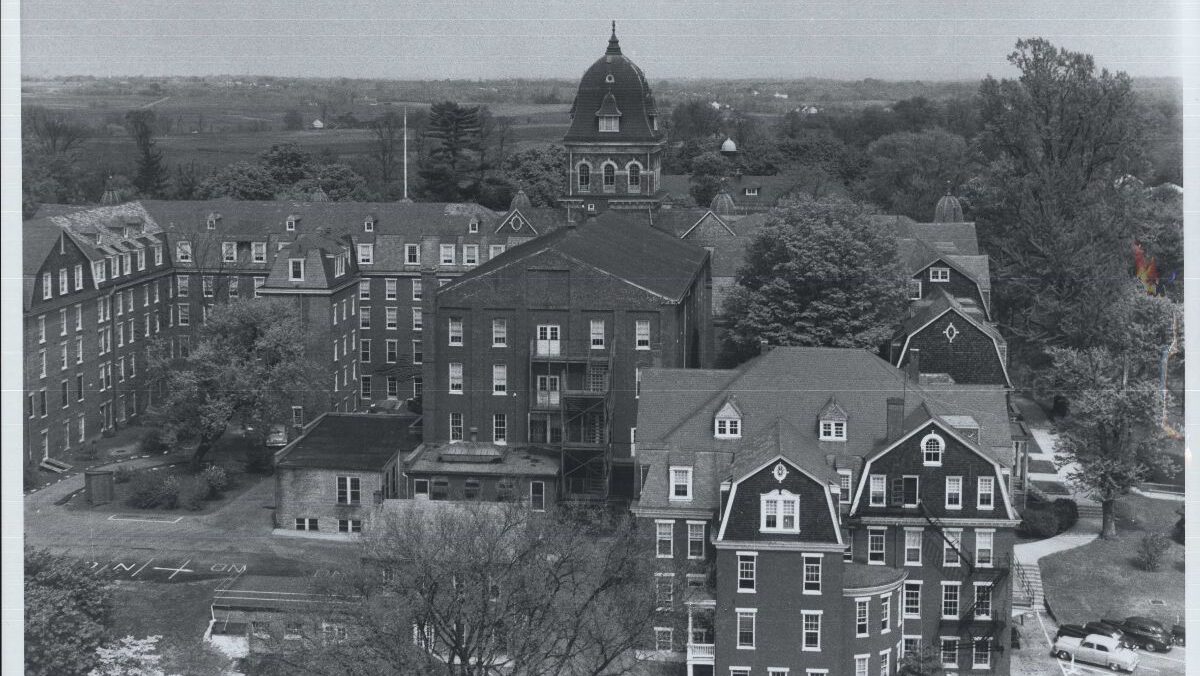
After my first semester living in a dormitory—"Old Main,” built in 1854—on campus, I ran out of money and I had two choices—drop out and get a job or become a commuter student by living at home. The only problem with commuting was that neither I nor my parents ever owned a car. We walked wherever we needed to go.
The college was located 20 miles away from my home. So, every morning, Monday through Friday for 3 years, I would get up at 5:30 a.m., eat a quick breakfast and make a sandwich for lunch, and then head out to Route 222 on the north edge of Ephrata where I hitchhiked to the outskirts of Lancaster. Then, either hitchhiked or walked two miles to the center of Lancaster where I could catch a local bus to Millersville, if I had the pocket money, otherwise, the Thumb Express. Lancaster had an enforced law against hitchhiking within the city limits, but, looking over my shoulder often, I was never caught. And then I would repeat this process in reverse, beginning at 4 p.m. in Millersville and arriving back home by 7 p.m. where my mother always had a supper plate waiting for me.

Current McNair Library on the MU campus.
I always had 9 a.m. classes, arrived on time 99.9% of the time, and received excellent grades. Literally, in sunshine, rain, sleet, or snow, my right arm was stuck out with my thumb begging people to stop and give me a ride. I’m not sharing this personal history with you as a tale of woe.
I did whatever was necessary, relentlessly, as is my style when something is important to me, to secure a college education and I soaked up learning as if it was the Elixir of Life, which it was. Looking back on my life, I now understand that this was part of my tempering process, like tempering a sword, alternating pounding it after extreme heat and then plunging it into cold water, often, which strengthens the blade. That hitchhiking-tempering was part of what made that alumni award for gay achievement possible.
So today, as I do eldering with young people of all colors and proclivities of the human rainbow (at my age, anyone under 50-years-of-age is a young person), I remind them, over and over again in many different ways, of Nelson Mandela’s wise advice, deep-tempered by his experience: “It always seems impossible until it is done.”
* * *
Donald Kilhefner Alumni Statement
Don Kilhefner, Ph.D., age 87, is a member of the Class of 1960, the first class to graduate under the new name, Millersville State College.
After graduating, Kilhefner taught history and German at Henry C. Conrad High School in suburban Wilmington, Delaware (1960-62). A major turning point in his life was when he was accepted among the first Peace Corps Volunteers to go abroad and, after a send off with President Kennedy in the Rose Garden of the White House, spent three years (1962-65) teaching history at Woizero Siheen Secondary School in Dessie, Ethiopia, the largest town in Wollo Province, the site of the only high school in a province then as large as eastern Pennsylvania—one high school. He also traveled widely in Egypt, Sudan, Eritrea, Kenya, and Tanzania, an exciting time to be in Africa as independence movements were successfully under way.
On his return to the U.S., he earned an M.A. degree in African history at Howard University (1966-1967) and was awarded a full fellowship at UCLA (1967-1970), working toward a doctorate in African and Islamic history while also active in the social justice movements then occurring across the U.S.
After the June 1969 Stonewall Rebellion that launched the Gay Liberation movement, Kilhefner, a gay man, played a central role in organizing the L.A. Gay Liberation Front (1969-1971), a militant gay and lesbian liberation organization with national impact, helping to start the long road to freedom for gay people. He took a leave of absence from his UCLA doctoral studies for what he thought would be two quarters. Instead, the well-being and welfare of LGBTQ people became his life’s work for the next 60 years.
Kilhefner is the vision carrier, co-founder (with Morris Kight), and founding executive director of the Gay Community Services Center (today called the Los Angeles LGBT Center) on Wilshire Blvd. in L.A. in 1971, the first such organization in history and then, as now, the largest such organization in the world. By 2019, the Center had an annual budget of $178 million with 700 employees and 800 volunteers. In 1979, Kilhefner also co-founded (with Harry Hay) the Radical Faeries, an international, gay-centered spirituality and consciousness movement focused on revisioning what it means to be gay.
Kilhefner is also a licensed clinical psychologist specializing in Carl Jung’s soul psychology, creating numerous community-based conferences and workshop efforts aimed at facilitating an understanding of gay development over the lifespan and facilitating intergenerational dialogues in groups as small as 12 and as large as 300 people. He has appeared in countless interviews, books, articles, videos, blogs and documentary films ranging from Some of Your Best Friends (1971), the first documentary about Gay Liberation, to the recent PBS documentary Cured, which included his role in forcing the American Psychiatric Association to remove its classification of mental illness for being gay or lesbian. Today, Kilhefner writes for LA Progressive (archives for his essays during the past 7 years), reads, and works pro bono publico with at-risk, creative young people weekly as a gay tribal elder at his home in Hollywood.
Kilhefner passionately stated, “I have always carried Millersville in my heart because it allowed this poor, young man from Ephrata thirsting for knowledge to receive a superb, foundational college education. I bow deeply with great respect and gratitude in the direction of Millersville University.”