
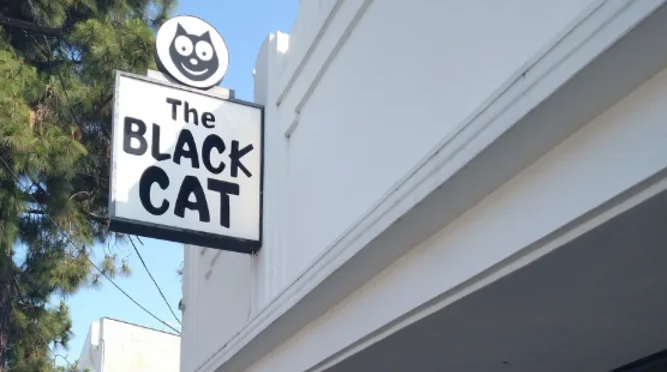
A minute before midnight on New Year’s Eve, all eyes were on the clock to celebrate and welcome in the year 1967 at the Black Cat, a small gay bar at 3909 Sunset Boulevard in the Silverlake section of Los Angeles. During the 1960s, Silverlake was attracting counterculture and creative people due to cheap rents in the neighborhood, and a visible gay enclave had emerged and was growing there. As the minute hand of the clock at the Black Cat reached 12, joy, friendly kisses, and hugs abounded among the gay-lesbian-trans well-wishers, a scene peacefully played out across L.A. that midnight.
Suddenly, shouts rang out: “You are under arrest!” Six undercover police officers in the bar began to arrest people for showing same sex physical affection in public, a crime under California Penal Code 647(a), called “lewd and lascivious conduct.” More uniformed LAPD officers who had been waiting outside rushed into the Black Cat as patrons were brutalized in the process of being handcuffed. One violently pushed headfirst into the jukebox. Another hit across the head with the thick end of a pool cue causing blood to flow. A bartender beaten unconscious. Customers fled through an exit door to escape arrest.
A few fled across Sunset Boulevard to a small gay bar called New Faces with the LAPD in pursuit. One was slammed to the floor inside the bar. The woman owner of New Faces asked for ID and likewise was knocked to the floor. The bartender was pulled across the bar, dragged outside, and brutally slammed against the sidewalk, rupturing his spleen.
Ultimately that night, 14 patrons were arrested for “assault and public lewdness.” There is unanimity about the facts of these raids. All accounts of the viciousness of the raid are similar and not in question—another violent example of gay-lesbian-trans dehumanization and oppression prior to Stonewall.
Welcome to the dangerous reality of being gay in public—unsafe spaces in 1967 when power was totally in the hands of hetero supremacists. In truth, most heteros then, and the LAPD served as an army of occupation and control in minority neighborhoods. Such gay bar raids were common occurrences in different parts of L.A. and elsewhere in the U.S. prior to the Gay Liberation Revolution. The Black Cat raid stood out for being particularly cruel and brutal.
Gay fear was widespread then. During the Spring of 1969, my boyfriend, Ricardo Alvarez, took me to my first gay bar in L.A., a small storefront beer joint with a jukebox (no touching or dancing allowed) named the Crown Jewel that catered to a gay Latino clientele, who were warmly welcoming, in downtown L.A. I nervously kept one eye on the front door and another on the back exit door, just in case. Finally, my fear grew to the point that we needed to leave.
In California prior to the early 1950s, a bar could lose its license for simply serving an alcoholic beverage, even a beer, to a gay or lesbian person. It was against the law. A 1951, historic California Supreme Court ruling (Stouman v. Reilley) overturned that law. Then, slowly, beer bars serving gay and lesbian patrons began to appear cautiously here and there, owned by men and women who were hetero, or who pretended to be hetero. The California Alcohol Beverage Commission would have refused to license an openly gay or lesbian bar owner at that time, citing the legal concept of “moral turpitude,” a behavior or act that violated the moral standards of the community.
In Los Angeles during the 1960s, gay and lesbian beer bars, usually of an ephemeral nature, like the Black Cat and New Faces, appeared if you knew where to find them, always by word of mouth. They were mostly beer bars because such a permit was the easiest to be awarded by the state ABC.
The Black Cat Protest Distortion

Picket signs by the 200 protesters at the February 11, 1967, demonstration in Silver Lake who were not there to protest the Black Cat raid, as historical revisionists falsely distort. Note: None of the three forbidden words--homosexual, homophile, gay—nor Black Cat appear on the signs. Courtesy: ONE Archives at the USC Libraries.
On February 11, 1967, about 200 people assembled in a large parking lot and nearby street corners adjacent to a building that housed a laundromat at that time and the then closed Black Cat bar (it went out of business in May 1967) at the northwest corner of Sunset Blvd. and Hyperion Ave. in Silverlake. A widely disseminated, false narrative had it that they were there to protest the Black Cat and New Faces raids. For example, Wikipedia writes, “…a civil protest of 200 attendees to protest the raids was held on February 11, 1967.” Fifty years later, the Los Angeles Times writing about the Black Cat, reported “…hundreds of people showed up to protest the raids.” An L.A. City historical plaque calls the 1967 demonstration, “…the first documented LGBT rights demonstration in the nation….” This simply is not true. All sorts of false claims have been made about the Black Cat. My aim in this article is to bring honesty and clarity to this important occurrence.
My sources are the few homophile publications and newsletter accounts reporting on the raids at the time, University of Southern California-ONE archival records at the USC libraries, and, particularly, discussions with Jim Kepner, who was the best grassroots journalist and historian of the Homophile period (1953-1970) and a speaker at the February 1967 demonstration.
Some of this confusion about the Black Cat protest stems from an article by filmmaker Eve Goldberg that appeared in the Gay & Lesbian Review titled “1967: Protest at the Black Cat (May-June 2012 and reprinted March-April 2025). Her sole source of information was Alexei Romanoff who falsely claimed, in extreme exaggeration, “This is where the first large demonstration of gay people in the nation, maybe in the world, happened. It happened right here in Los Angeles.” The problem is that it never happened as Goldberg reported the story with 200 Black Cat protesters. Goldberg, in a gracious response to my correction published in G&LR (May-June 2025), wrote, “Thank you for your corrections and additions to my article about the Black Cat. I appreciate learning more about our history.” That false narrative about the Black Cat protest, however, had started in gay publications and history telling many years prior to Goldberg’s 2012 article.
Let me explain what actually happened that February day in 1967.
Approximately 200 demonstrators did assemble, but they were not there to protest the Black Cat raid. Undoubtedly, some participants were motivated by their anger at the Black Cat and New Faces violence. The demonstration, however, had been called to protest LAPD harassment and arrests of young, counterculture hippies that had been happening along the Sunset Strip in West Hollywood and in Black and Brown communities. Four demonstrations were called for: the Sunset Strip, Silverlake, South L.A. and the San Fernando Valley. The Sunset Strip and Silverlake protests did materialize. The South L.A. and Valley demonstrations never happened. I speculate because those black and latino communities saw the calls for action as just another example of outside, white people telling largely black and brown communities what to do. Kepner reported that the person central to the call for and organizing of the demonstrations was the homophile owner of The Carriage Trade, a more or less high end restaurant on N. LaCienega Blvd. in West Hollywood.

L.A. City Historical Site plaque at the Black Cat restaurant in Silver Lake, continuing the historically false narrative of the 1967 protest there.
Critically important to an historical understanding is the fact that the protest organizers forbade the use of the words “homosexual,” “homophile,” or “gay” in any way at the Silverlake demonstration, supposedly, because it would turn people off and cause them to avoid participating, thus diverting attention from the real reason for the protest. Take a look at the protest signs at the 1967 demonstration in the photo below. None of the three forbidden words appear nor any mention of the Black Cat. It was an insult to and turning a deaf ear toward the debasement and real oppression of gay-lesbian-trans people by the LAPD in 1967, but such were the ways before the Gay Liberation Revolution. That censorship is a good example of what Oscar Wilde meant when he wrote, “The love that dare not speak its name.”
At least, when Jim Kepner, who had been fully involved in the Homophile effort in L.A., spoke at the demonstration that day, he made known his own anger with the ban of the three words. Defiantly, in his speech whenever Kepner had wanted to use one of the forbidden words, he said instead, “the word I’m forbidden to speak,” his own personal fighting back against the censorship.
In truth, there was a small Black Cat demonstration that day, adroitly and correctly using the much larger crowd as protective cover. Kepner reported to me that a handful of protesters [whom I honor and respect] made a very quick appearance in front of the Black Cat and then crossed Sunset Blvd. to protest very briefly at New Faces. When a LAPD car parked nearby on Sunset, they rapidly disappeared into the larger assembled crowd, probably out of fear and for safety. Kepner quipped that if you blinked you might have missed them. That handful represented a harbinger of the awakening of gay anger and civil disobedience against hetero supremacy that came into full bloom with the militant Gay Liberation movement, a revolutionary liberation movement, not a civil rights effort, just a few years later.
Why the Distortion of Gay History?
Years before the 2012 publication of Goldberg’s article, I had been amazed with how quickly and how many gay people had mindlessly turned the falsely-named Black Cat protest into something it never was, fetishizing and clearly distorting the event. It was a puzzlement at first how quickly that false narrative had spread in the gay community. Here are a few of the ideas that have shaped my thinking about the falsification of that event and the rewriting of gay history generally.
First, a historical perspective is essential both politically and culturally. During the past 75 years of an organized, visible LGBTQ presence in U.S. society and particularly the last 55 years shaped by the pivotal Gay Liberation Revolution (1969-c.1985), the gay historical pendulum has moved from left to right politically and culturally from gay-centered essentialism and fighting back through reactive and proactive community organizing to the gay assimilation, elite capture and conformity of the Neo-Homophile period (1985-present). More detailed analyses of these issues are provided in previous articles in LA Progressive, “Understanding L.A. Gay History” and “Elite Capture in the Los Angeles LGBTQ Community (And Everywhere Else).” They explain why there is no community-based, united gay movement today at the present hour of peril to LGBTQ survival as well as shedding light on the rewriting of gay history, including the Black Cat distortion.
History is generally written or not written by those in power politically at any given period of time and reflect the political and cultural values of that period, like what is happening now with President Trump and MAGA U.S.A. In gay terms, that has been true in Los Angeles and nationally in the radical shift from the conservative Homophile period (1953-1970) to the militant Gay Liberation era and the more gradual transition from the Gay Liberation period to the assimilationist Neo-Homophile era currently. Many examples of that recent historical revisionism from Gay Liberation to the Neo-Homophile era abound if you have eyes to see. Here are a few examples.
The 1969 Stonewall Rebellion and Gay Liberation movement, which are the progenitors of the current PRIDE events, have been completely erased from PRIDE celebrations in We Ho, L.A., and elsewhere, as if they had never happened. The LA LGBT Center pretends it magically began in late 1971 on Wilshire Boulevard, erasing its true history stemming from the revolutionary L.A. Gay Liberation Front in 1970 and 1971. An understanding of a grassroots, participatory, and community-based agenda created by Gay Liberation has been erased during the Neo-Homophile era by values based on elite capture, assimilation, and entertainment 24/7 with LGBTQ people becoming passive, paying spectators. Community organizations have been colonized by businessmen and women with capitalist values and behavior, replacing radical social change and community organizing agendas. Writings I have submitted elsewhere have been published with words like “Gay Liberation Revolution” edited out and replaced by words like “gay resistance,” a term so overused and underperformed today that it is fast becoming a meaningless platitude.
With the above historical framework in mind, I have heard and read repeatedly during the past 30 years that the Black Cat protest with 200 demonstrators had actually occurred. That narrative also says so-called homosexual people were actively fighting back against hetero supremacy through a large, peaceful demonstration at the Black Cat during the late Homophile period in 1967. The historical subtext is that fighting back did not begin with Stonewall and by Gay Liberationists in 1969 but by Homophiles in 1967, thereby diminishing the pivotal importance of the revolutionary Gay Liberation era during the 1970s. The only problem with that revisionist Black Cat story is that it is not true.
A second reality that has shaped my thinking about the rewriting of gay history, including the Black Cat, is the abysmally low level of LGBTQ historical and cultural IQ of most LGBTQ people of whatever age. Large numbers of LGBTQ people live their lives largely in the self-absorbed present tense, knowing little of what went before them. That historical and cultural amnesia is also reflected in the larger society with the watering down of high school and college history courses, many colleges requiring only one or two history courses in a STEM world. With notable exceptions, university gay studies courses are few and far between or watered down, and gay-centered journalism, particularly investigative reporting, has vanished.
Not long ago, I showed the documentary Some of Your Best Friends, the first about the early Gay Liberation movement filmed largely in L.A., to a group of high school students. In the discussion afterward, a young gay man exclaimed, “Why haven’t I been showed this before? It inspires me.” Young gay people under 35-years-old have been shaped by the core values of the current Neo-Homophile period. It’s all they know. PRIDE is a party. An Intellectual discussion at any level becomes a struggle. There is a reason why.
Recently, I was 20 minutes early for a haircut appointment in West Hollywood and picked up a copy of The Advocate/Out magazine, once two significant, separate publications in the gay community, now cojoined. I had not encountered either magazine in 20 years and attentively read it from cover to cover. OMG, every single article was about mass entertainment or an LGBTQ entertainer. Not a word about gay-centered politics or culture. I was stunned. I subscribe to A Journal of Lesbian and Gay Studies. After reading most issues, even that journal leaves me intellectually hungry.
If this is true for the gay literate media world, I will not venture into the swamplands of visual and social media culture. It only gets worse, as you are well aware, or maybe not, depending on your age or general awareness level. This is not a race- or class-based elite screed. I was raised in a working poor family and that sensibility still informs my world view.
The reason I bring up the rewriting of gay history/the Black Cat protest is because if you can be made to believe those stories, it’s a short walk to making you believe in a larger historical context that there is Afrikaner genocide happening in South Africa today. An understanding of history is important.
My personal political and spiritual infrastructure is as a pragmatic idealist and optimistic progressive. There is a concern now, however, like never before, about whether there is an LGBTQ generation that is awakening to the perils in front of us and motivated, indeed driven, enough to want to build upon what has been created for the first time during the past 75 years in the U.S. Or will the past 1,000 years of hetero supremacy in the West reassert itself and wipe most of it away?